SinoJapaneseWar.com
August 1, 1894 – April 17, 1895
Jiawu Zhanzheng 甲午戰爭 日清戦争 Nisshin senso
|
Battle of Seonghwan ( Song Hwan) July 29, 1894 Chinese 成歡之戰 Japanese 成歓の戦い
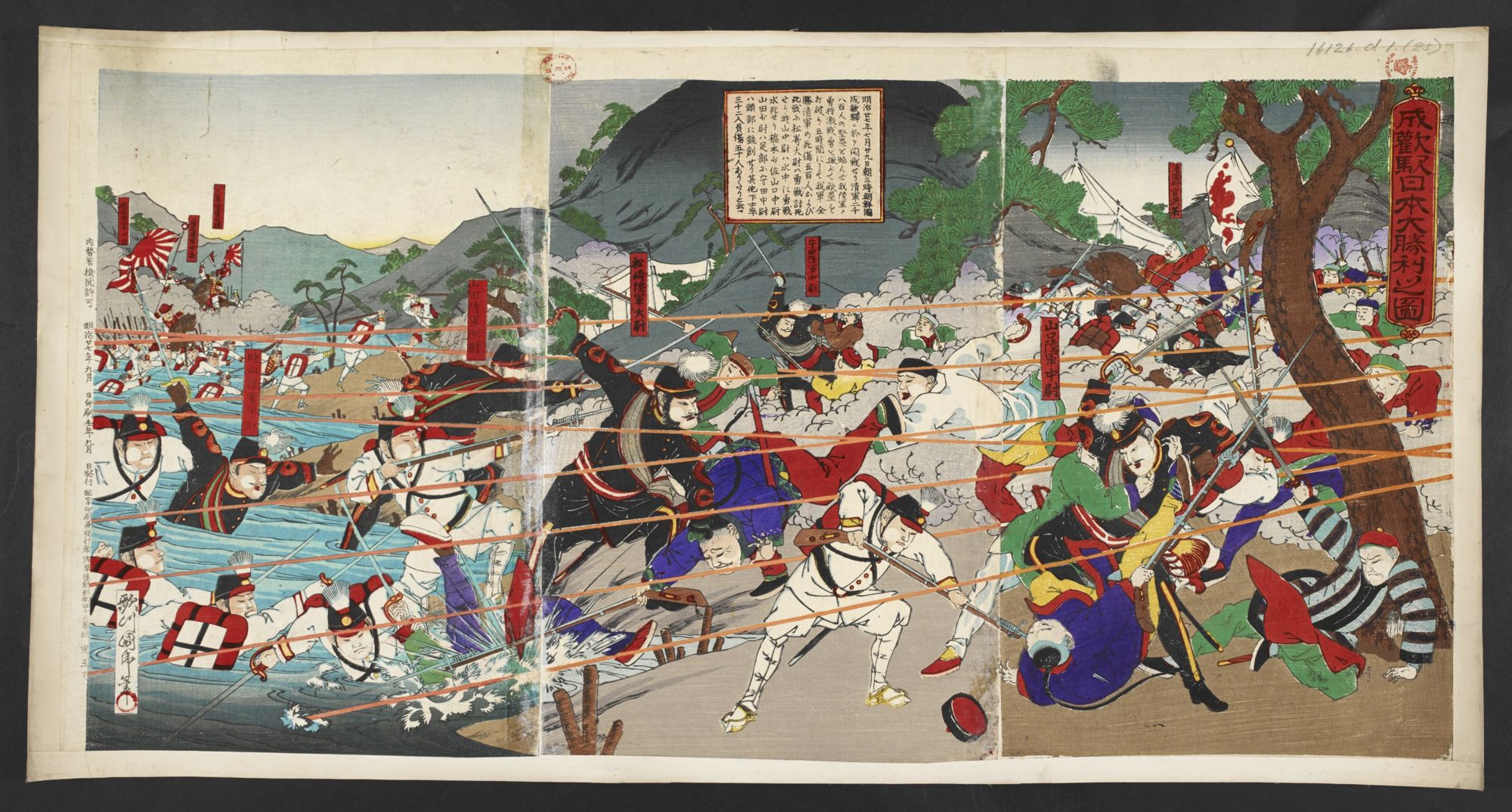
Woodblock print of the Battle of Seonghwan . Click image for larger view . Utagawa school school artist . Immediately following the date of these sea battles, hard fighting began at and around Asan, where the body of Chinese troops was entrenched. On the 23rd, the Japanese send a cavalry detachment was dispatched to watch the movement of the Chinese .The Chinese force had to be destroyed before they could be reinforced and link up with the Chinese army known to be somewhere near the Yalu . It was also felt some decisive land action was needed to keep the support of the pro-Japanese court faction. On the 25th, Gen. Oshima Yoshimasa (1850 - 1926 ) left Seoul with the bulk of his force of 4,000 and was close to the Chinese position at Su-sa-chang by the 27th .
Gen. Oshima Yoshimasa 大島 義昌
General Nie Shicheng 聂士成
General Nie statue in Tianjin . The general was killed in Tianjin during the Battle of Tianjian during the Boxer Rebellion in 1900 . On the 26th, General Oshima also received from Otori the news of the naval engagement on the coast, which had taken place the preceding day, and the troops were immediately informed of the victory, which filled them with enthusiasm and impatience to rival the success of the navy. The Chinese force, under command of Nie Shicheng 聂士成 ( 1836 - 1900 ) when they foresaw the probability of a Japanese attack, decided not to resist it at Asan, where their retreat would have been cut off by the sea, but chose, with great skill, a strong defensive position near Seonghwan, which they fortified with great pains. Reinforcements, expected from China, had been lost when the Kowshing was sunk. The road from Seoul to Asan at Su-sa- chang has to cross two small rivers, one of which forms a pond : the ground is entirely without cover and cut up with paddy-fields ; beyond these, there is a ridge of hills. The Chinese broke the bridges, dammed the rivers, and built six redoubts protected by abbatis (a type of fortification designed to slow and disrupt enemy troop movements on the hills. )
Chinese troops drilling in Korea
Lieutenant-Colonel Taketa From: Heroic Japan : a history of the war between China & Japan Eastlake, F. Warrington 1896 The Japanese force was based at Yongsan and on July 25th, began to march on Asan, where the Chinese were located. The Japanese arrived at Su-sa-chang, five miles from the Chinese position, before noon of the 28th of July ; the officers, with their field-glasses, soon discovered the Chinese entrenchments, gaily bedecked with a liberal supply of flags. Some Japanese officers disguised themselves, and approached very near to the Chinese lines : when they returned in the evening, General Oshima summoned a hasty council, in which it was decided that, owing to the strength of the position, and the difficulty of approach through paddy- fields exposed to the enemy's fire without shelter, a night attack was necessary. The troops were not informed of the plan, but suddenly awakened at midnight, when noiselessly and without confusion they marched towards the enemy. The Japanese were divided into two wings : the right wing, under Lieutenant-Colonel Taketa, consisted of four companies of infantry and one company of engineers, and was to make a strong diversion on the enemy's left ; the left wing, under General Oshima, consisted of nine companies of infantry, one battalion of artillery, and one company of cavalry ; by a circuitous route it was to attack the flank and rear of the Chinese right wing.
The Battle of Songhwan From : Scenes from the Japan-China War Inouye, Jukichi 1895
Captain Matsusaki crossing the Anseong river . Captain Matsusaki with a company of infantry, was at the head of the right wing ; the two streams were forded with difficulty, the water reaching to the shoulders, and a narrow road turning to the left led across a pond and through paddy-fields to a hamlet. The darkness of the night and the difficulties of the road soon threw the Japanese into confusion. Some detachments lost their way, and Leiut.-Col. Takeda called to the interpreters to inquire the road at the Korean houses, when suddenly a white figure darted past and shouted. The Chinese soldiers ambushed in the hamlet immediately opened a heavy fire. The Japanese lying down behind the embankments returned the fire, but they were in a very embarrassing position ; the nature of the ground hampered their movements, and they were crowding up under the enemy's fire. Lieutenant Tokiyama with twenty men, in their anxiety to push forward to the assistance of the vanguard, jumped into the pond where it was deepest, and were drowned.
Action around Asan
Captain Matsusaki encouraged his men to hold their ground, standing up on the embankment of the rice-field and waving his sword ; a bullet hit him in the thigh, but he still continued to brave all danger until another bullet killed him. Gradually reinforcements came up, and the Japanese charged the Chinese, driving them out pf the village into the paddy-field to the south. This skirmish, which was called after the name of the ford of Anseong (the second of the two streams), lasted from 3:00 to 3.30 a.m. 5:30 a.m. the battle was renewed by an attack on the redoubts. At this time the left wing, under Oshima, came into action, and a heavy artillery fire was directed on the Chinese entrenchments. The Japanese shells bursting inside the forts made great havoc among the Chinese. The Chinese abandoned the fort at 5:30 AM and retreated to Seonghwan . It was estimated that the Japanese had 2,500 men and the Chinese, under Gen Nie Shicheng had 3,000. According to the Japanese, the Chinese lost 500 men killed or wounded, 8 guns and a large amount of supplies, with the Japanese losing 6 officers and 82 men killed and wounded . About 1,500 Chinese were able to march north to unite with the Chinese army at Pyongyang .The Japanese departed Asan on July 31 and returned to Seoul on Aug 5, in a triumphal entry with the spoils of the campaign to impress the Koreans. This was the first foreign battle for the Japanese in 300 years since the Imjin War of 1592 - 98 . Captain Matsusaki and a bugler, Kiguchi Kohei became the first popular heroes of the war. He had sounded it once when a bullet passed through his lungs, throwing him down. His comrades tried to take the bugle away, seeing the wound was fatal. He wrested it from them, lifted it again to his lips, sounded the charge once more with all his strength, and fell back dead.
Kiguchi Kohei was a fixture in Japanese textbooks till 1945 . Even though he was fataly shot, he continued to blow his bugle, signaling attack until he died at the attack on the Ansong river on July 29th, 1894 . The force that was sent under General Nie Shicheng to Asan to quell the insurrection there, treated the natives with kindness and were consequently much liked. The general had funds entrusted to him, to distribute among the poor people who were suffering from want, and miraculous to say he did not steal the money, but spent all, and even, it is said, some of his own, in benevolence to the Koreans. These good deeds fared Nie well, Nie was able to use his good relations with the local population to avoid the Japanese army on the march to Pyongyang in the middle of August ..
Japanese troops returning to Seoul on August 8, 1894, marching through the victory arch constructed under orders of Gen. Oshima Yoshimasa after the victory of the Battle of Seonghwan . The Chinese had been routed and a considerable amount of Chinese weapons and stores were seized . Note the Korean and Japanese flags . The Japanese claimed they were liberating the Koreans from Chinese rule and Tonghak rebellion . A lull in the action, Landings Military operations had been pushed on very vigorously during the days preceding the formal declaration of war on August 1, 1894, but very strangely, after that solemn act, there was a lull which lasted nearly two months.
During this lull of military operations, which extended from the 29th of July to the middle of September, the Japanese landed troops at Chemulpo (Incheon), Wonsan and Pusan (Busan ). The latter port was however soon abandoned, as it lay too far from the seat of war, and Incheon and Wonsan became the chief landing- places for their forces, especially the former. The Chinese were also hurrying forward their troops both by sea and land. The armies of the three Manchurian provinces were slowly marching south, some to Pyongyang and others to the banks of the Yalu, the border river between China and Korea, where a second army was being formed. Near the mouth of this river was the chief landing-place for the Chinese troops which were conveyed by sea.
|
||||
|
1894 - Formal Declarations of War Aug 1, 1894 |
Sept 15, 1894 |
|||